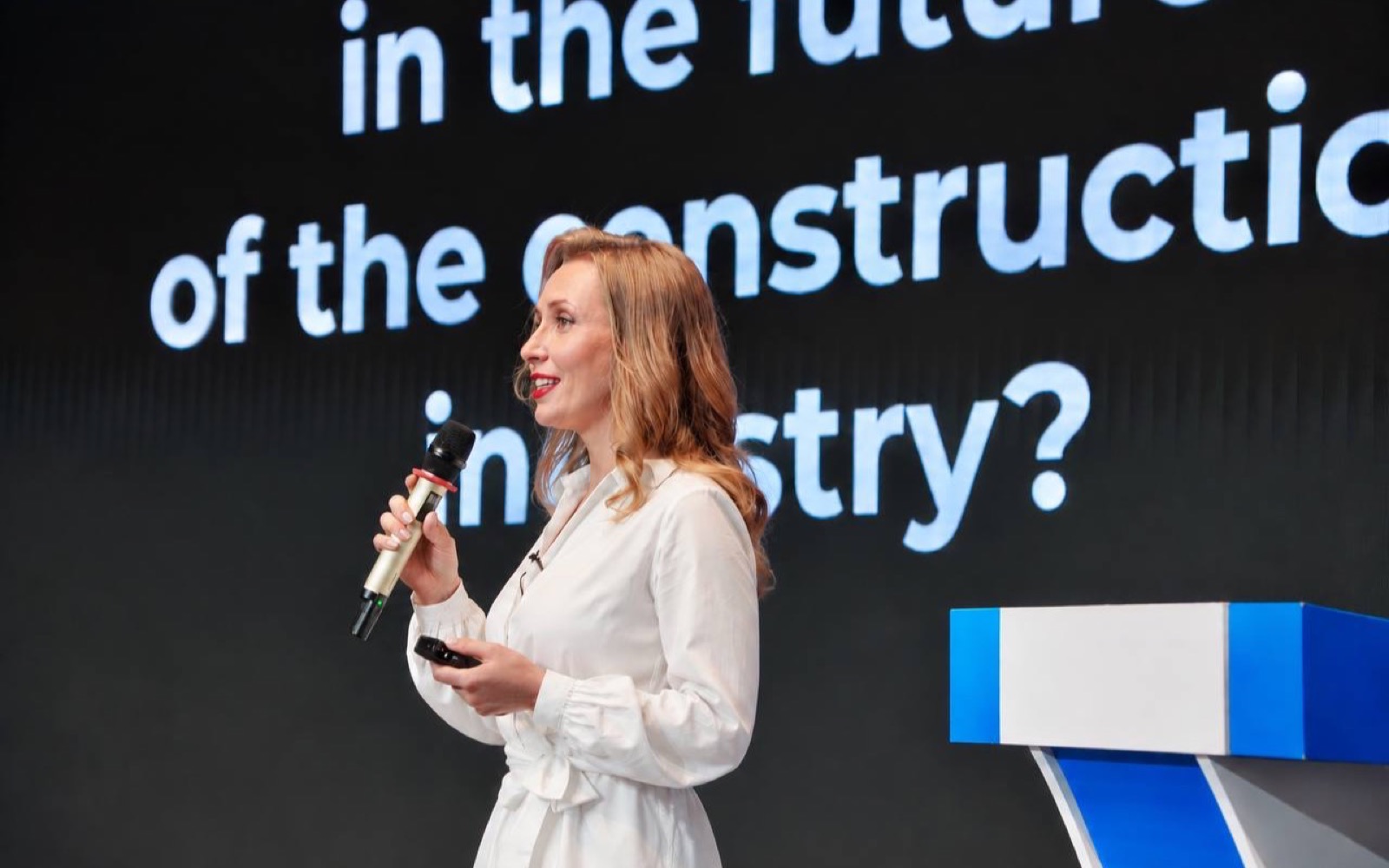
How will cities, construction technology and the economics of real estate change in the coming decades? These questions were central to Anna Minakova’s presentation at the 5th International Conference Smart and Sustainable Cities 2026, held in Moscow on 9–11 September 2026.
Anna Minakova, a futurist, CEO of ESG Expert and co-founder of the Centre for Sustainable Development in Construction and Real Estate Operations, presented the results of the international study The Future Is Built: Sustainable Construction Trend Watching Foresight 2050. It examines global trends in green construction and possible scenarios for the industry through the middle of the twenty-first century.
The study brought together the views of 70 experts from 20 countries and examined political, economic, social, technological, environmental and legislative factors that may shape the future of real estate. The project took first place in the Innovation category at GPM Awards Russia 2025.
The future of real estate: from environmental requirements to development strategy
The construction industry faces several long-term challenges at once: climate change, resource constraints, rising expectations for the quality of urban environments and the need to improve the economic performance of assets.
To assess how these factors may interact, the research team used foresight and the PESTEL framework. This approach examines not isolated technological innovations but the relationships between changes in the economy, society, regulation and the environment.
One conclusion is that green construction will follow different trajectories by region. Some countries will prioritise reducing carbon footprints, while others will focus on adapting buildings and cities to flooding, water scarcity or extreme temperatures.
Designing the real estate of the future will require attention not only to the building itself but also to long-term changes in the environment in which it operates.
Green real estate and the cost of capital
The environmental performance of buildings is becoming increasingly relevant to financial planning. Energy efficiency, resource use, greenhouse-gas emissions and climate risks can affect operating costs, investment decisions and assessments of an asset’s prospects.
The study identifies green bonds, public subsidies, grants and tax incentives among the promising financing mechanisms for environmental projects.
For investors and property owners, this broadens the framework for valuing an asset. Alongside construction costs and current income, future expenditure, adaptability and risks across the asset’s life cycle become more important.
The development of national green-certification systems is another important direction. International standards such as BREEAM and LEED coexist with local tools that reflect legislation, climate and market conditions. In Russia, this role is served by the Klever green-building certification system.
Technologies that will change construction
A separate part of the presentation addressed technologies that may change how buildings are produced, operated and supplied with energy. The experts considered digital transformation, new construction materials, additive manufacturing and energy solutions.
In time, 3D printing may allow some structures to be produced directly on site. Reusing materials can reduce demand for primary resources, while distributed energy can turn buildings into active participants in the energy system.
Another direction is the use of digital tools to assess and manage assets. Combining data about a building, its site, infrastructure and external risks can help developers, banks, insurers and property managers make better-informed decisions.
Technology has strategic value when its implementation is tied to specific goals: reducing costs, improving operational efficiency, managing risk or improving the quality of the urban environment.
The circular economy
One of the principal environmental trends is the shift to a circular economy, in which materials retain value and are reused rather than becoming waste when an asset reaches the end of its service life.
A building can be regarded as a bank of materials.
The idea is to identify at the design stage which elements can be dismantled, restored and reused decades later. In this scenario, a building is not merely a final consumer of resources but a potential source for future projects.
Implementing this approach requires new design principles, suitable materials, solutions for disassembly and systems for tracking building components. An asset’s value will also depend on its capacity to preserve resources and return them to economic use.
Urban environments: technology must work for people
The study also addresses the social dimension of sustainable development. Experts noted growing interest in biophilic cities, where architecture and infrastructure are integrated with the natural environment.
Green roofs, vertical gardens, rain gardens and other nature-based solutions can help cities adapt to climate change and improve conditions for residents.
However, stronger environmental requirements for real estate coincide with concerns about housing affordability. Green construction must therefore account not only for environmental performance but also for people’s economic circumstances.
The future of urban environments depends on the ability to combine technological progress, quality of life, efficient resource use and affordable real estate.
Metabuild: turning foresight into a management tool
A practical continuation of the study is the Metabuild, project, whose concept brings real-estate market participants together on a digital platform. Its intended users include developers, construction companies, design organisations, property managers, banks and insurers.
The project aims to support comprehensive real-estate assessment and risk forecasting using data about assets and their surroundings. This can help market participants consider not only current building characteristics but also factors that may affect long-term viability and economic performance.
Metabuild is at an early stage of development. It demonstrates how research into long-term trends can provide a basis for practical digital solutions.
The central conclusion
The future of real estate is a range of scenarios for which organisations can prepare in advance.
Businesses need to consider long-term change when designing assets, shaping investment strategies and selecting technology. Foresight connects environmental requirements, economics and technological decisions into a coherent system for managing future risks.
Follow Anna’s updates