
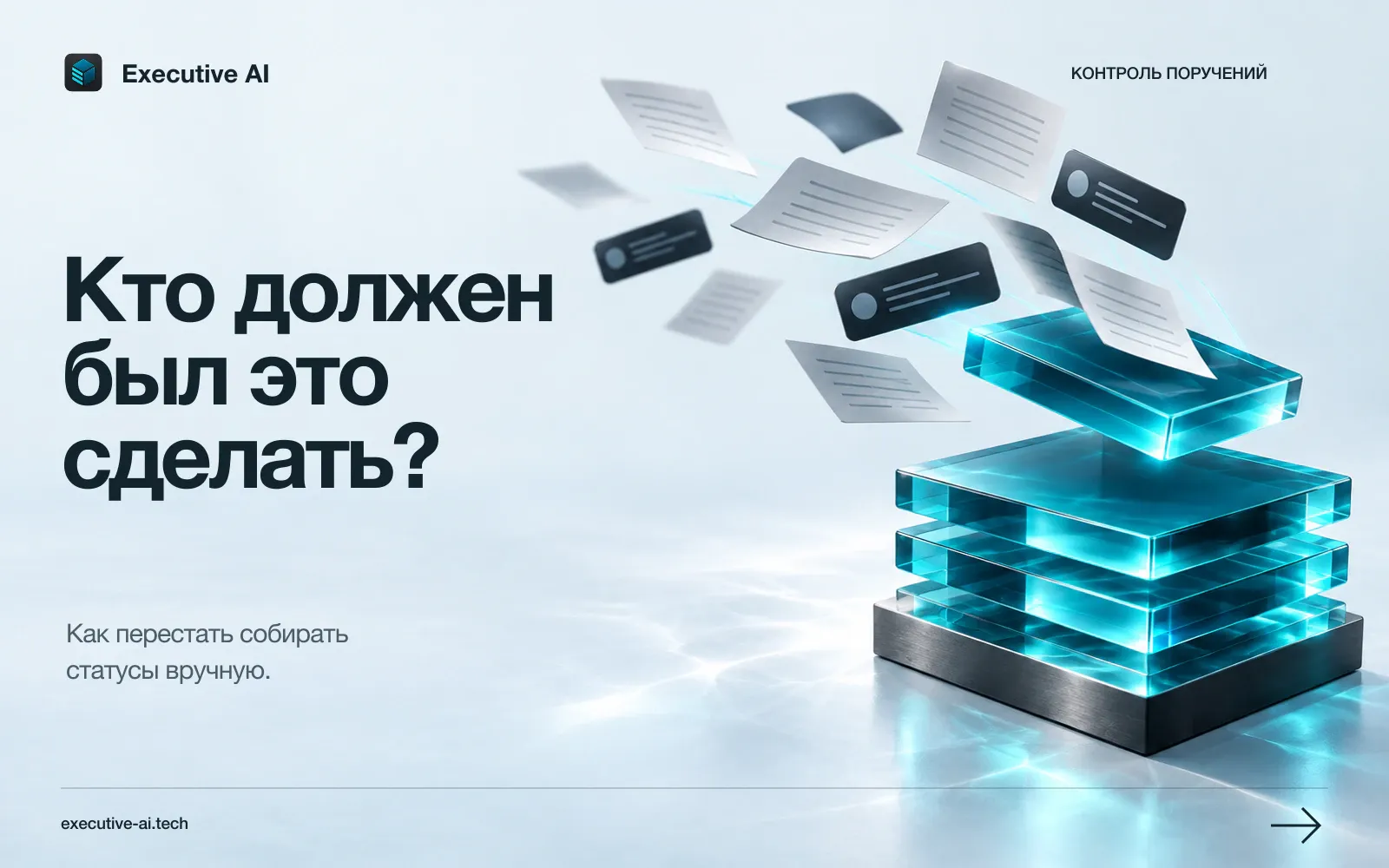
Everyone agreed during the meeting. The chat says “accepted”. A deadline was apparently named. By the next meeting there is still no result, and the executive has to ask the same question again: “Where are we now?”
At some point, management turns into work spent servicing work. Someone has to remember promises, check whether dates changed, find the latest file and reconstruct the whole picture manually.
I call this manual dispatcher mode. Tasks are formally assigned, yet the current state of the company still lives in one person’s head.
Three key points
- 01
Task control starts with a clear outcome, one owner and a confirmed deadline, not with more reminders.
- 02
A task tracker stores cards but may not preserve the path from conversation to decision and next action.
- 03
AI can collect and structure work data; deadlines, priorities and acceptance remain human decisions.
How executives enter manual dispatcher mode
Assignments rarely begin in a tidy format. They emerge halfway through a call, after a voice note, in a document comment or in the phrase “let’s do it by Friday”.
The conversation continues. Scope changes, another person joins and the deadline is clarified elsewhere. The tracker receives a short card without the reason or definition of done, if it receives anything at all.
By Friday there is activity, messages and files. What is missing are five simple answers: what outcome is expected, who owns it, which deadline is current, what is blocking progress and what should happen next.
The executive normally closes this gap and becomes a living integration between Telegram, meetings, documents and tasks.
Why a task list is not enough
“Prepare a proposal” can mean three different outcomes. The executive expects a client-ready document. The manager expects an outline. The designer expects approved copy before layout begins.
A green status cannot resolve different expectations. The team first needs to define the outcome, then preserve the source of the decision and the active deadline.
Separate three events: an assignment was captured, the owner accepted the commitment and the outcome was accepted. “I’ll take it” is not finished work. A “done” label is not acceptance.
Six parts of a controllable assignment
- Outcome. The document, action or change that must exist.
- Owner. One person accountable for the outcome.
- Deadline. A date or event confirmed by the owner.
- Definition of done. What the person accepting the work needs to see.
- Source. The meeting, message or decision that created the assignment.
- Next action. What happens after the latest update and who acts.
If a field is missing, the system should ask rather than guess. An invented date creates the appearance of order without a real commitment.
Where AI helps business processes
AI is useful where executives currently spend attention mechanically assembling the picture. A voice summary, conversation or document can become a structured draft of decisions, possible assignments, missing fields and questions for confirmation.
A person then checks the wording, confirms the owner and deadline, and accepts the outcome. Automation removes manual formatting without transferring accountability to a model.
Executive AI works inside familiar Telegram communication. It can receive voice notes, text, documents and reminders while retaining project context. This is useful when a thought already exists but there is no time to turn it manually into a plan, task list or document draft.
What changes for an Executive AI user
Vladislav Vasilyev, entrepreneur, co-founder of DoVracha and yabloko~, and CPO at Stellar Wave, uses Executive AI for reminders, voice notes, text, documents and project context.
When he was asked to describe his first experience, his first response was:
“Can I just tell Wilhelm and have him format it properly?”
This is not yet a long report with savings percentages, and it does not mean AI runs the project by itself. It does show a change in behaviour: the person no longer delays capturing a thought until there is time to sit down and format it.
The thought enters the system naturally and returns as a structure that can be checked and used. Less information remains only in one person’s head.
How to test task execution control in seven days
Start with one real workflow: preparation for a weekly meeting, customer commitments, partnerships or one active project.
Record four baseline measures: how often the executive asks for status manually; how many assignments lack an owner or deadline; how long a consolidated update takes; and how many decisions fail to reach a next action.
For seven days, give Executive AI the voice notes, agreements, documents and reminders for that project. Ask it to structure the material and return questions when the owner, deadline or outcome is unclear.
At the end, compare the work process rather than the number of AI messages. Is the current picture easier to recover? Are there fewer manual reminders? Can the team see where a task stopped?
What the system should not do without confirmation
AI should not promise a client deadline, change team priorities, appoint an owner or accept work when those actions have management consequences.
The boundary is simple: the system gathers facts, shows gaps, prepares options and surfaces the next step. A person confirms commitments and makes decisions.
Task control should not become employee surveillance. Executives need outcomes, blockers and decisions to make, not a ranking based on message volume.
Frequently asked questions
How is assignment control different from a task tracker?
A task tracker stores work after someone has formulated it. Assignment control starts earlier: identifying a decision in conversation, turning it into a verifiable outcome, confirming the owner and deadline, and preserving later changes.
Can AI appoint the owner automatically?
It can suggest a person from the discussion, but a human should confirm the assignment. Mentioning a name in a message is not the same as accepting a commitment.
Do all business processes need to move into a new system?
No. Start with one recurring workflow. If it becomes clearer and needs less manual coordination, expand the working context gradually.
Test Executive AI on one real project
Executive AI is available free for seven days. Give it working agreements, voice notes, documents and assignments, then compare how much manual coordination remains.
Get access to the 7-day demo →
For help with setup, contact the team on Telegram: @bios_team.